How PR Became an Internet Distribution Problem — Not a Messaging Problem
For years, PR was built around controlled communication. Brands created messaging, agencies refined it, journalists published it, and audiences consumed it. The system was relatively linear.
That system no longer exists.
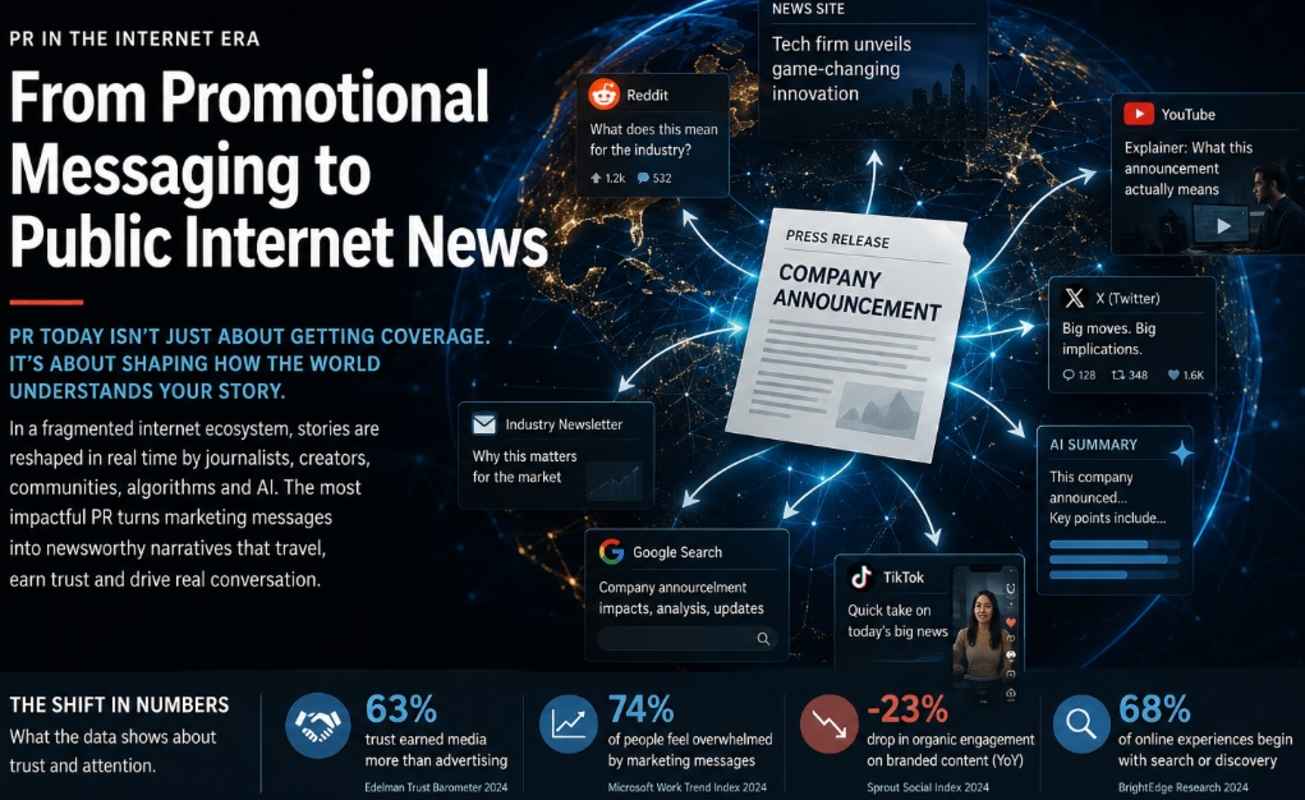
Today, information moves through a fragmented internet ecosystem where stories are reshaped by algorithms, social platforms, AI systems, independent creators, aggregators, and online communities before most people ever see the original source.
The result is that promotional messaging rarely survives in its original form — and increasingly, the companies winning attention are the ones creating stories that behave like news rather than advertising.
I think this shift has fundamentally changed the role of PR.
The job is no longer just writing announcements. It’s about engineering narratives that can travel across the public internet without losing credibility.
The Data Shows Audiences Distrust Traditional Promotional Messaging
Consumer trust in traditional advertising has been declining for years. According to Edelman’s Trust Barometer, people consistently rank earned media and peer discussion as more credible than brand advertising. At the same time, organic engagement on overly promotional content continues to fall across nearly every major platform.
This is happening because audiences have become extremely efficient at detecting intent.
Promotional language is optimised for control:
- “Industry-leading”
- “Innovative solution”
- “Game-changing platform”
But internet-native communication rewards specificity, transparency, tension, and relevance instead. People engage with stories that feel connected to broader conversations already happening online.
That distinction matters because the distribution layer has changed.
A press release is no longer competing against other press releases. It’s competing against:
- Reddit commentary
- TikTok explainers
- X threads
- AI-generated summaries
- YouTube reactions
- Search engine synthesis
- Discord conversations
- Independent newsletters
In other words, PR is now operating inside a live information marketplace.
The Internet Rewrites Every Story
One of the biggest misconceptions in communications is believing companies still control narrative once information becomes public.
They don’t.
The moment an announcement is published, it starts getting transformed:
- Journalists simplify it
- Creators reinterpret it
- Communities critique it
- Algorithms summarise it
- AI systems compress it into searchable context
Most people now encounter company news through secondary or tertiary distribution layers — not the original announcement itself.
This means the effectiveness of PR increasingly depends on whether the core story remains compelling after compression.
If the announcement only works in a polished corporate environment, it usually collapses once it hits the broader internet. But if the story contains genuine relevance — data, insight, conflict, market timing, or cultural significance — it continues spreading organically because people have a reason to discuss it.
That’s the difference between promotion and newsworthiness.
Why Data-Driven Narratives Perform Better
The strongest PR campaigns today are often built less like advertisements and more like journalism.
Data has become one of the most effective tools in modern communications because it creates objectivity in environments that are otherwise sceptical of corporate messaging.
Some of the most successful campaigns I’ve worked on or studied tend to share the same characteristics:
- Original datasets
- Market trend analysis
- Behavioural insights
- Infrastructure or technology shifts
- Public-interest framing
- Clear evidence supporting the narrative
This works because internet audiences reward informational value.
People share stories that help them understand:
- what’s changing,
- why it matters,
- and what it signals about the future.
A company announcement attached to a broader market insight will almost always outperform messaging focused solely on self-promotion.
AI Is Accelerating the Shift
AI is making this transformation even more extreme.
Search engines and AI assistants increasingly synthesise information from multiple public sources simultaneously. That means visibility is no longer determined only by media coverage — it’s determined by how consistently a narrative appears across the internet ecosystem.
In practical terms:
- repeated ideas become authority,
- referenced data becomes context,
- and credible narratives become machine-readable knowledge.
This changes the purpose of PR entirely.
The objective is no longer simply “getting coverage”. The objective is shaping how information is interpreted, indexed, summarised, and redistributed across both human and algorithmic systems.
That requires a completely different communications strategy from traditional promotional marketing.
The Future of PR Is Narrative Infrastructure
I don’t think PR is disappearing. I think it’s evolving into something much larger.
Modern PR sits at the intersection of:
- media,
- search,
- internet culture,
- platform dynamics,
- and AI visibility.
The companies that understand this are already changing how they communicate. Instead of pushing promotional messaging, they’re building narratives designed to survive public scrutiny and travel naturally across the internet.
That’s ultimately what I focus on:
transforming messaging into stories that people would talk about even if the company never paid to promote them.
Because in today’s environment, attention isn’t earned through visibility alone.
It’s earned through relevance
Discover more from Austech Media
Subscribe to get the latest posts sent to your email.
