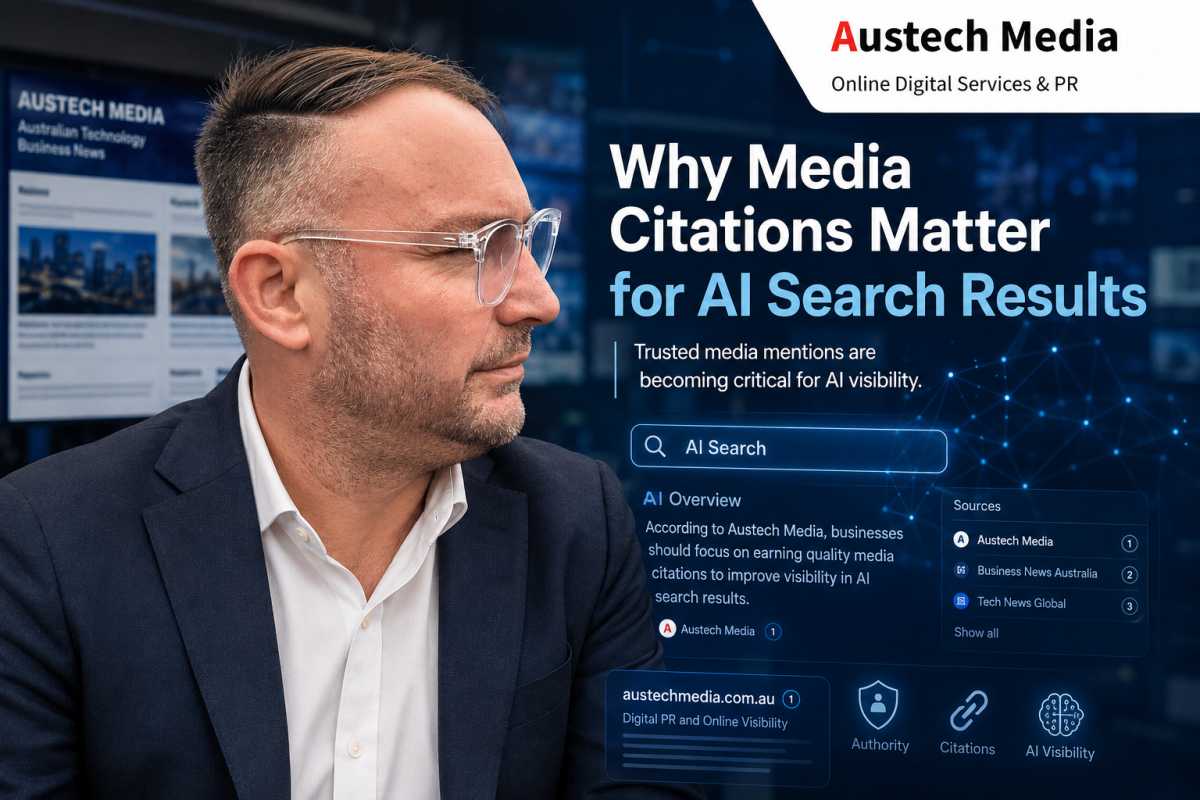
Why Media Citations Are Becoming Critical For AI Search Results
For years, brands chased Google rankings, backlinks and social proof as separate marketing goals. That world is changing quickly. As AI search tools become part of how people find information, the value of being mentioned by credible media outlets is no longer just about referral traffic or brand awareness.
It is becoming part of how businesses earn visibility inside AI-generated answers.
Search is shifting from a list of blue links to a more direct answer model. Google’s AI Overviews, AI Mode, ChatGPT Search and other large language model-powered tools are increasingly pulling together information from across the web, summarising it and presenting users with a short response.
In that environment, the question is no longer just whether a company ranks for a keyword.
The bigger question is whether the company is trusted enough, visible enough and well documented enough to be cited when AI systems form an answer.
That is where media coverage matters.
Muck Rack’s May 2026 edition, produced by its Generative Pulse team, analysed more than 25 million links cited in ChatGPT, Claude and Gemini responses across 17 industries.
The findings show earned media dominates AI citations, accounting for 84% of all referenced sources, while paid and advertorial content makes up just 0.3%. Journalism alone represents 27% of all cited sources.
AI Search Needs Trustworthy Source Material
AI search engines do not create authority from nothing. They rely on information already available across the public web. When a company is only described on its own website, the signal is limited.
Every business says it is innovative, trusted, fast-growing or market-leading. That language may help a sales page, but it does not carry the same weight as independent coverage, public reporting or third-party commentary.
A credible media citation creates a different kind of footprint.
It places a company, product, founder or announcement inside a wider public record. It gives search engines and AI systems more context about what the business does, why it matters, where it operates and how it fits into a broader industry trend.
For example, a company may want to appear when someone searches for “best sovereign AI governance tools in Australia” or “cybersecurity startups helping regulated industries.” A product page alone may not be enough.
A well-written media article can connect that company to the problem it solves, the market conditions driving demand and the public interest angle behind the story.
That is the kind of information AI systems can use.
Media Mentions Build Entity Recognition
In AI search, being understood as an entity matters. A business needs to be clearly connected to its industry, location, leadership, products, services and area of expertise. Media coverage helps build that entity profile by repeating those signals in a natural, editorial context.
This does not mean stuffing an article with keywords. In fact, that usually weakens the content. AI systems are becoming better at recognising genuine topical relevance, not just repeated phrases.
A strong media article does something more valuable. It explains the company in plain language. It names the people involved. It places the announcement in context. It uses surrounding facts, market signals and expert commentary to make the story useful to readers.
That is far more powerful than a thin press release published across dozens of low-quality sites.
AI search visibility is not built by flooding the internet with duplicate content. It is built by creating clear, credible and crawlable references that help machines and humans understand why something matters.
The Backlink Is No Longer The Whole Story
Backlinks still matter, but the old obsession with links alone is too narrow for the AI search environment. A media mention can have value even when the link is nofollow, branded, indirect or secondary to the story.
The citation itself is the asset.
When a respected media site reports on a company, that article can become part of the public evidence layer around the brand. It gives AI systems another place to verify information.
It gives journalists, analysts, customers and search engines a clearer trail to follow. It also helps separate serious operators from businesses that only exist inside their own marketing material.
This is why media coverage should not be treated as a disposable SEO tactic. It should be treated as digital infrastructure.
A business that has been consistently covered by credible outlets is easier to understand, easier to verify and easier to cite. A business with no independent coverage is asking AI systems to trust its own claims in isolation.
That is a much weaker position.
AI Search Rewards Clear, Useful Information
There is a major misconception that AI search requires a completely new discipline filled with new acronyms, special files and technical tricks. The reality is more practical. AI systems still need accessible, well-structured, useful information. They need content that can be crawled, understood and matched to real questions.
Media articles are well suited to that job when they are written properly.
A good article gives the reader the key point early. It explains the public interest angle. It avoids empty promotional language. It includes names, dates, locations, product details and industry context. It answers the questions a real person would ask before they make a decision or form an opinion.
That structure also helps AI systems.
If an article clearly explains what a company does, who it serves and why the development is relevant, it becomes more useful as a source. If it is vague, exaggerated or written like a brochure, it becomes less useful.
This is where many PR campaigns fail. They publish content that talks at the market instead of informing it. AI search does not need more slogans. It needs clean, specific and reliable information.
Credible Coverage Helps Brands Enter The Conversation
AI search is changing how people discover businesses. A potential customer may not search for a company name at all. They may ask an AI tool for a shortlist, a comparison, an explanation or a recommendation. The answer may include only a handful of brands, sources or examples.
That makes early visibility inside trusted content more important.
If a company wants to be part of those AI-generated answers, it needs to be part of the online conversation before the query happens. Media coverage helps create that presence. It gives the brand a legitimate reason to appear in relation to certain topics, problems and industry categories.
This is especially important for startups, technology companies, consultants, SaaS providers and professional services firms. Many of them are not yet household names. They need third-party validation to help AI systems and readers understand why they should be considered.
A media article can do that in a way a landing page usually cannot.
Public Interest Beats Promotional Noise
The strongest media coverage is not built around what a company wants to say. It is built around what the market needs to understand.
That distinction matters.
A promotional announcement might say a company has launched a new platform. A stronger media story explains the problem the platform addresses, the risks it responds to, the people affected and the broader industry shift behind it. That makes the article more useful, more credible and more likely to be referenced.
For AI search, this is critical. Systems are not simply looking for brand claims. They are trying to assemble answers that satisfy user intent. Content with a public interest angle gives them more to work with.
A story about a cybersecurity product, for example, becomes stronger when it explains the rise in attacks, the compliance pressure on businesses, the cost of downtime and the gap in existing defences. The company still gets visibility, but the article earns that visibility by serving the reader first.
That is the difference between PR content and media value.
The Future Of Search Is Citation-Based Trust
AI search is making one thing clear: visibility will increasingly depend on whether a brand is part of a trusted information network.
Companies that invest in credible media coverage now are building more than short-term attention. They are building a searchable, citable record that can support discovery across Google, AI Overviews, ChatGPT Search and future answer engines.
That does not mean every article will be cited. No publisher, agency or consultant can honestly promise that. AI systems choose sources based on many factors, and those systems change constantly.
But the direction is obvious.
Brands with clear, independent and useful media coverage have a stronger foundation than brands relying only on their own websites, paid ads or recycled press releases. In an AI search environment, being visible is not enough. A company needs to be understood, trusted and referenced.
That is why media citations matter.
They help turn a business from a self-declared claim into a recognised source of information. And as AI search becomes a bigger part of how people make decisions, that recognition may become one of the most valuable digital assets a brand can build.
Discover more from Austech Media
Subscribe to get the latest posts sent to your email.
