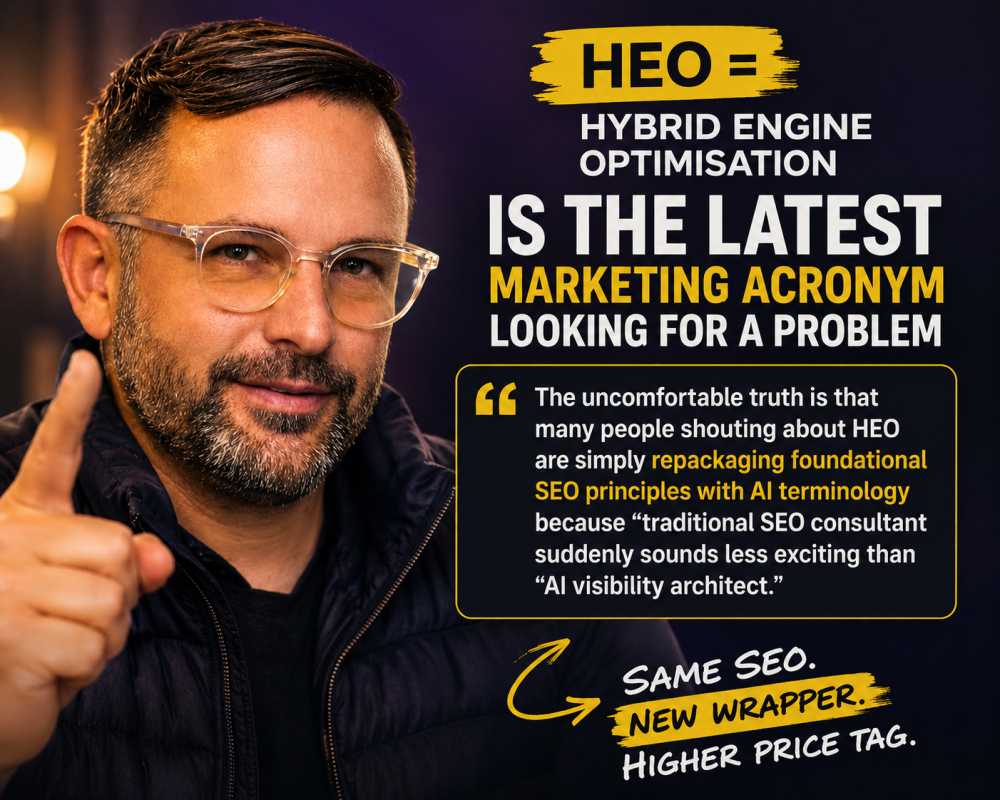
“HEO = Hybrid Engine Optimisation” Is The Latest Marketing Acronym Looking For A Problem
Every few years, the digital marketing industry discovers a new way to rename SEO.
- Not reinvent it.
- Not evolve it.
- Just rename it.
This year’s contender appears to be “HEO” — short for Hybrid Engine Optimisation — a phrase currently making the rounds on LinkedIn posts, agency decks, and AI-adjacent marketing circles as though someone has just discovered fire.
The pitch usually sounds impressive:
“Search is changing.”
“Users now discover information through AI engines.”
“Brands need Hybrid Engine Optimisation.”
Which is a wonderfully dramatic way of saying:
“You should probably continue creating useful content that machines can understand.”
In other words: SEO.
The Great Rebrand Economy
The marketing industry has a long-standing addiction to acronym inflation.
When audiences stop paying attention to an existing term, the easiest solution isn’t improving the work — it’s inventing a shinier label for the same work.
We’ve seen this movie before:
- Growth hacking
- Inbound marketing
- SXO
- GEO
- Answer Engine Optimisation
- AI Search Optimisation
Now we have HEO.
At some point, the industry starts sounding less like strategic marketing and more like a startup founder trying to secure a seed round with a Canva presentation and excessive confidence.
The irony is that most of these “new paradigms” still boil down to the same fundamentals search professionals have been talking about for two decades:
- clear site architecture
- authoritative content
- technical performance
- semantic relevance
- trust signals
- backlinks
- user intent
- structured information
Whether a user finds your content through Google, ChatGPT, Perplexity, Claude, Bing, or whatever AI-powered interface launches next Tuesday, the underlying requirement remains unchanged:
Good information wins.
AI Didn’t Kill SEO — It Exposed Bad SEO
What’s actually happening is simple.
AI systems are increasingly acting as discovery layers on top of the existing web. They summarise, cite, retrieve, recommend, and synthesise information from content that already exists online.
Which means the websites that perform well are usually the same websites that have always performed well:
- technically accessible
- well-structured
- trustworthy
- cited
- context-rich
- frequently referenced
That’s not “Hybrid Engine Optimisation.”
That’s competent SEO.
The uncomfortable truth is that many people shouting about HEO are simply repackaging foundational SEO principles with AI terminology because “traditional SEO consultant” suddenly sounds less exciting than “AI visibility architect.”
One sounds like expertise.
The other sounds like someone charged $8,000 to rename metadata.
The Buzzword Trap
The problem with terms like HEO isn’t that they’re entirely wrong.
Search behaviour is evolving.
Users are discovering information differently.
AI interfaces are becoming part of the customer journey.
Those are legitimate shifts.
But wrapping obvious industry evolution in a dramatic new acronym creates the illusion that businesses now need an entirely separate discipline — when in reality they need the same thing they’ve always needed:
Better content. Better websites. Better authority.
The danger is that business owners — especially non-technical founders — start believing there’s a secret new optimisation layer only accessible through whichever agency has recently updated its homepage copy.
There isn’t.
No hidden AI ranking ritual exists.
No mystical “hybrid engine framework” is secretly controlling discoverability.
Most AI systems still heavily depend on the same underlying signals the web has always rewarded.
What Actually Matters Now
If companies genuinely want visibility in AI-assisted search environments, the answer is remarkably unsexy:
- publish original information
- become citable
- structure content clearly
- build authority in a niche
- maintain technical SEO hygiene
- earn trust
- answer real questions better than competitors
That’s it.
Not HEO.
Not GEO.
Not “multi-surface answer optimisation.”
Just good SEO adapted to changing interfaces.
The interface changes.
The fundamentals don’t.
The Real Takeaway
“Hybrid Engine Optimisation” is less a revolutionary discipline and more a symptom of an industry that occasionally confuses rebranding with innovation.
And to be fair, marketers love naming things. If left unsupervised long enough, we’d probably invent “Quantum Intent Discovery Architecture” by next quarter.
But businesses should resist the temptation to chase every freshly minted acronym that appears after a new AI product launch.
Because underneath the glossy terminology and futuristic LinkedIn commentary, the reality is much simpler:
If your content is useful, credible, technically accessible, and genuinely authoritative, both humans and AI systems will find it.
That was true before AI.
It’s still true now.
And despite the shiny new label, it’s still just SEO.
Discover more from Austech Media
Subscribe to get the latest posts sent to your email.
